Pricing Results Good Ideas Highest Quality A/B Tests Ingredients For Success
Discuss

Uncover high-probability A/B test ideas.
Run them as high-powered experiments.

Jakub Linowski With Jakub designing experiments, guiding analysis, and helping you decide with confidence.

Choose a conversation starter:

5-10% opportunities → 4 experiments

to uncover 5-10% tests worth retesting.

Choose

Base Includes:

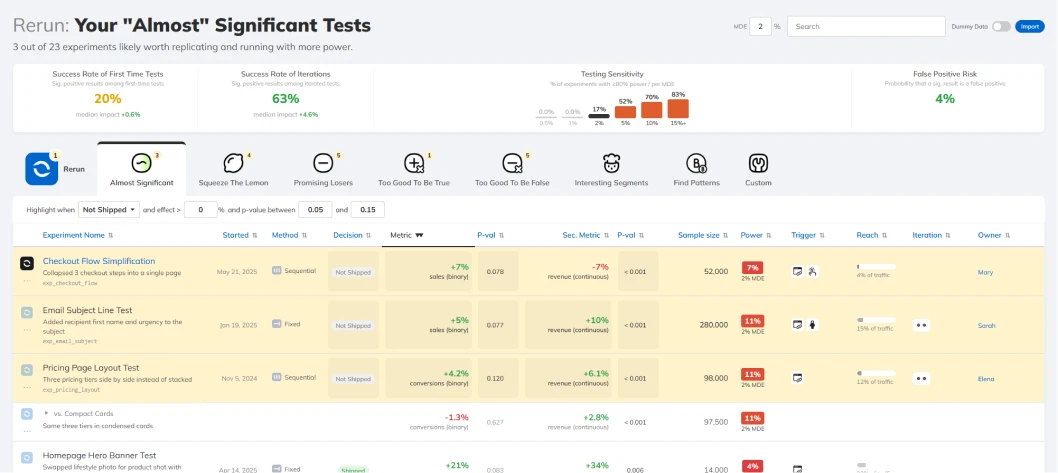
Experiment Repo Integration & Scan

Integration dev work to access your experiment repo through API or a CSV export.

Prioritized Opportunity List

Opportunities ranked by scenarios — weak but promising results, strong ones worth doing more of, and negative results worth inverting.

Impact Estimates and Power Checks

See relative effect estimates for each idea along with power calculations to make sure they can be tested with 80% power.

4

Experiment Designs

Detailed experiment concepts (Figma) with predefined test parameters: metrics, MDEs, power, triggering, decision rules, and statistical tests.

Base Price ~$9,500 USD

Minimum Requirements: You have a dev team, 50k+ monthly visitors, and have run 100+ A/B tests.

15-30 opportunities → 4 experiments

to uncover 15-30 high-probability test ideas.

Choose

Base Includes:

Opportunity Review & Prioritized List

We'll review 3-5 key pages based on over 600 prior experiments from GoodUI and deliver 15-30 experiment ideas ranked by expected impact with annotated screenshots.

Impact Estimates and Power Checks

See relative effect estimates for each idea along with power calculations to make sure they can be tested with 80% power.

4

Experiment Designs

Detailed experiment concepts (Figma) with predefined test parameters: metrics, MDEs, power, triggering, decision rules, and statistical tests.

Base Price ~$9,500 USD

Minimum Requirements: You have a dev team and 50k+ monthly visitors.

Add-Ons All The Way To Results

Customize and Discuss without Add-Ons

Book a 25 min intro call with Jakub

Have Something Else On Your Mind? Discuss Something Else

Historical Experiment Results

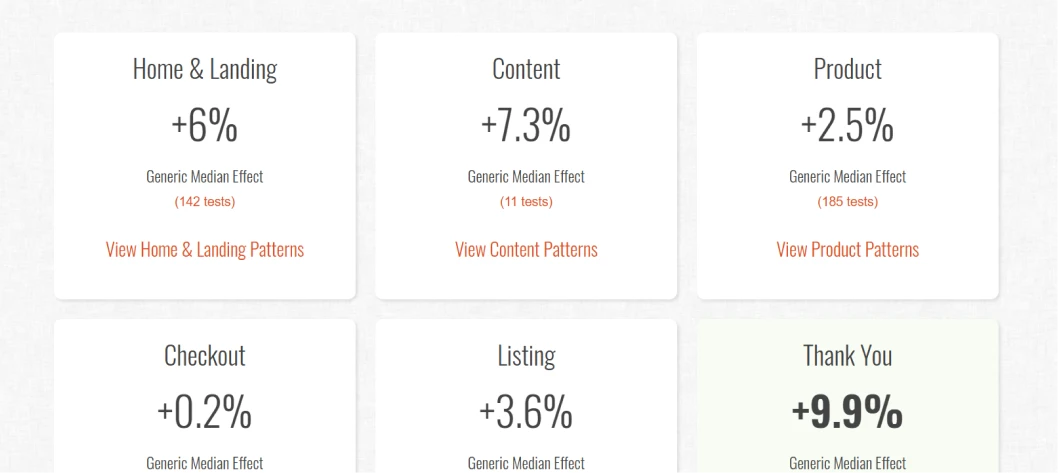
Relative median effects from past experiments you can expect on projects
for metrics such as: LEADS SALES SIGNUPS REVENUE

(Medians only show the mid point. Some projects are higher. Others are lower.)

+3.1%

on smaller experiments

1 IN 3 WIN RATE

Source: GoodUI data; N = ~600

+13.5%

on larger “leap” experiments

4 IN 5 WIN RATE

Source: Linowski "Leap" projects; N = 50

Worth noting: 1/3 of experiments are negative — testing protects you from shipping changes that hurt your metrics, and some can even be inverted into wins with future iterations.

SCREEN TYPES WE HAVE THE MOST EXPERIENCE DESIGNING & OPTIMIZING FOR

Landing &
Home Pages
Product
Pages
Listing
Pages
Signup
Funnels
Checkout
Funnels
Pricing
Pages

HI, I’M JAKUB

Jakub Linowski

OVER

15yrs

experience designing front-end UI A/B tests

COACHED

~100

experimentation & growth teams

PUBLISHED

~600

experiments on GoodUI

HIRED BY

Microsoft
LinkedIn
Booking.com
And others

WITH

2

design degrees

AND A

Love

for stats & numbers

WHERE DO HIGH-PROBABILITY
IDEAS COME FROM?

1

Hands-On Experience

Our ideas come from over 15 years of experience designing ~1,500 front-end UI A/B tests. I've worked with companies like:

Our Client Logos
2

Coaching & Learning From Growth Teams

I've coached and learned from ~100 growth teams — sharing what works, what doesn't, and replicating winning patterns.

MicrosoftReverbFluke MetroBaremetricsUmbracoYummlyVivaRealVoldersMettler ToledoBackstageThomasnetDrip AgencySnocksKenhubExpert InstituteExamine.com3DHubsBomgarDigital MarketerLovehoneyJared Kayoutlet.comNorman Records 686.comShmoodySvsound.comiBood.comFINN ElevateGetNinjasDesignlabPhorestUpliftsHomer LearningChaos GroupASICS ...
Learning From Growth Teams

Teams I've coached and learned from include: Microsoft, Reverb, Fluke, Metro, Baremetrics, Umbraco, Yummly, VivaReal, Volders, Mettler Toledo, Backstage, Thomasnet, Drip Agency, Snocks, Kenhub, Expert Institute, Examine.com, 3DHubs, Bomgar, Digital Marketer, Lovehoney, Jared, etc.

3

Actively Observing The Leaders

I actively track what leading ecommerce companies are A/B testing and how they evolve. This is a highly impactful source of successful optimization ideas.

Observing The Leaders

EXPECT THE HIGHEST
QUALITY A/B TESTS

Designed
in FigmaFigma
1

CLEAR TEST DESIGN CRITERIA

Our experiments are designed with attention to detail which include setting triggers, custom metrics, owners and starting / stopping rules.

Designed
in FigmaFigma
2

ULTRA CLEAR DIFFERENCES

All our experiments contain clear differences between the control and variation with annotated screenshots. When you look back at your experiment 1 year later the differences remain clear.

3

NOTE TAKING

When we discuss tests during calls, we capture notes and decisions — it’s iteration fuel.

4

SAMPLE ESTIMATES

Our experiments come with upfront sample estimates to minimize false positive rates.

5

EXPLORATION INCLUDED

The first idea is rarely polished, free from confounders. During early exploration of any A/B test we push boundaries and generate more than one idea — widening the design space; opening conversations about new variables. Only then do we decide what’s in; what’s out or a future test idea.

Customize and Discuss without Add-Ons

Book a 25 min intro call with Jakub

See Add-Ons

INGREDIENTS FOR SUCCESS

1. Upfront ROI & Testing Sensitivity Check
Before we start, we'll check the return on investment based on historical data and optimization potential. Depending on your testing sensitivity (the smaller the effect, the more samples or visitors are needed to satisfy statistical requirements) we'll also determine what type of experiments, whether and where we can run them.
2. Clear Meaningful Business Metrics With Targets
Before we start, we'll agree to business metrics that are meaningful to you (ex: less so: clicks, page visits, time on site, etc. More of: acquisition, referrals, average order value, transactions, leads, etc). You'll define these along with targets needed for success. If targets are unrealistic, we'll tell you.
3. All Optimizations Are A/B Tested
All optimization ideas that we propose will be designed as A/B tests. Controlled experimentation is one of the most reliable methods for learning about the effects of particular changes.
4. Compound If Possible
When we see opportunities to combine multiple changes into a larger leap experiment, we'll let you know. This way, bigger leap experiments open up the potential for larger effects (which are also easier to detect, faster, with less traffic - one of many possible strategies).
5. 80% Statistical Power With Sequential Stops
Before we run each test, we'll do a sample size calculation based on probable effects from similar experiments run in the past. Generally this hovers around ~3.1%, but will be adjusted lower or higher depending on the test design. We will also use sequential statistics to determine if we can stop the test earlier.
6. Room For Iteration
Iteration is an ingredient present in all of our projects as it increases the odds of success (including an increase in our ability to turn a 1st failed attempt around).
7. Your Own Development Team
You will provide a dedicated front-end developer with at least 2 full days of availability per week for any project.
8. Variation Over Compromise
When we find ourselves in situations with a difference in opinion (normal), we'll typically steer you away from compromise towards handling this through an experiment design path. This is done by adding new variations or turning them into new test ideas.
9. Democratic Ideation + Autonomy
Although compromise is to be avoided, democratization of the experimentation process is highly encouraged. Multiple and testable ideas should come from diverse people on the team — with autonomy on experiment ideas.
10. Modern Experimentation Platform + Peek Protection with Early Aborts
Implement a reliable experimentation platform such as: Eppo, ABSmartly, Convert, Growthbook with modern stats (SRM checks, sequential testing, custom metrics, triggering, post-hoc / exploratory analysis, guardrail metrics, etc).
11. Testing Velocity + Concurrency
Since roughly 1 / 3 experiments succeed, experimentation becomes more successful with multiple attempts and with iteration. Since individual experiments require variable time frames (ex: 1 to 12 weeks) to detect a predefined effect, industry standard practice is to run experiments concurrently where possible.
12. Adaptable Metrics
It's not just conversion rate. It's also lead quality. Over time we'll be adjusting what we measure as we learn what matters more.
Customize and Discuss without Add-Ons

Book a 25 min intro call with Jakub

See Add-Ons